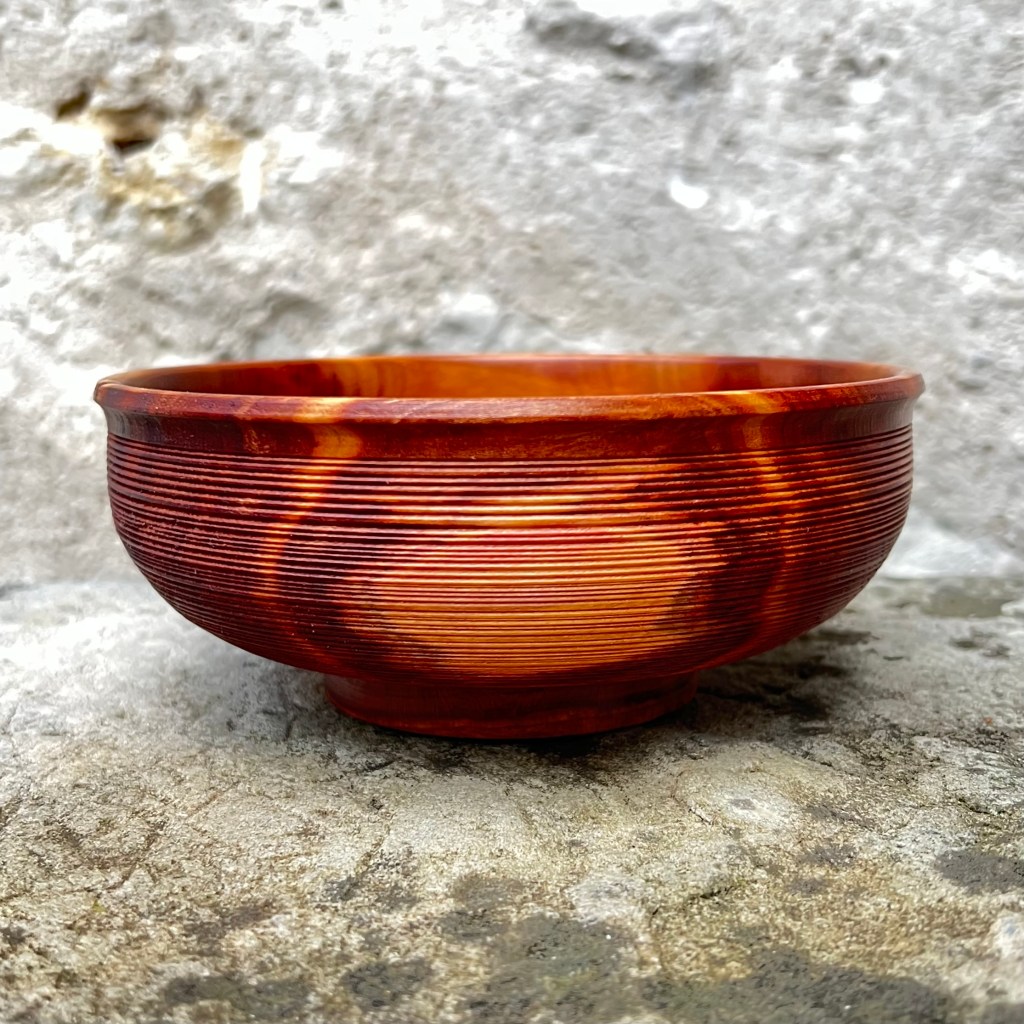
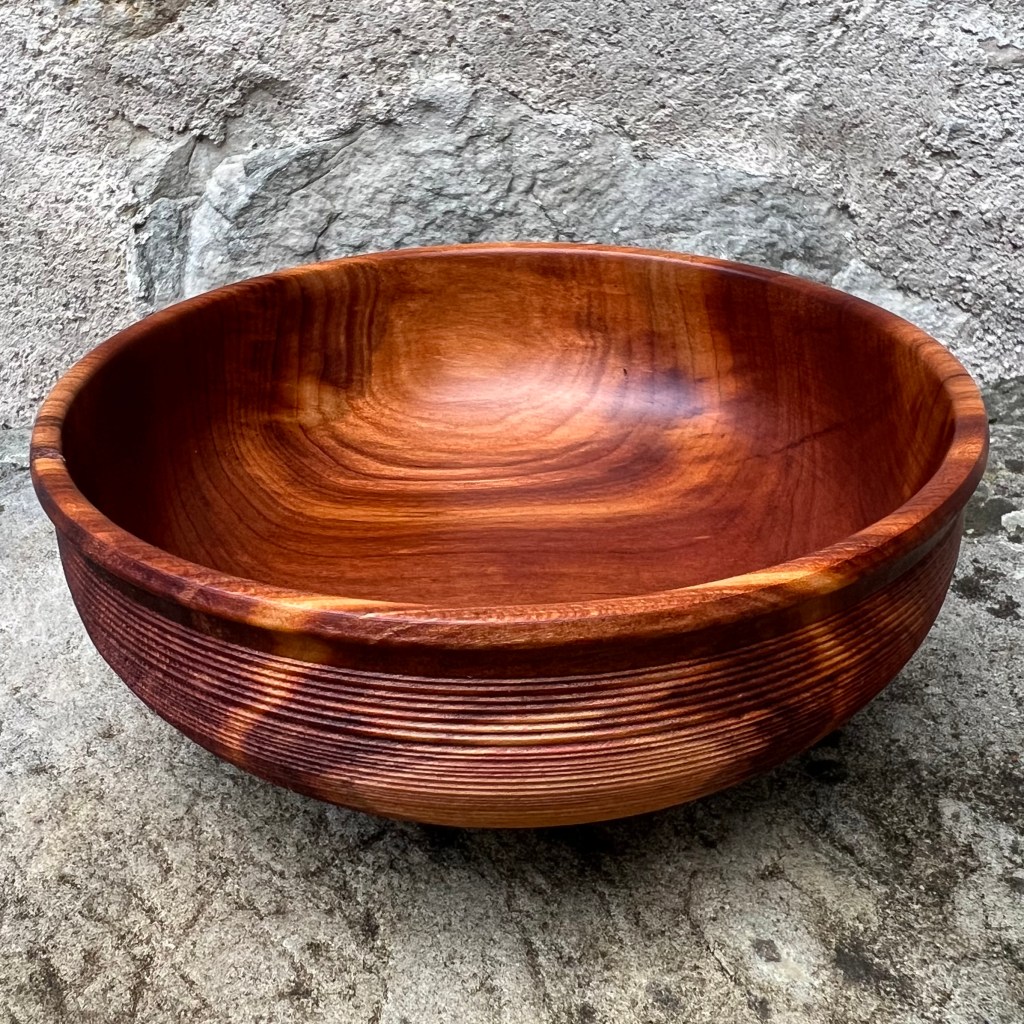
Bowl — wood species unknown?

We call it Craig’s List on steroids. My wife, a prolific user of Le Bon Coin, had saved a search for “wood” with the hope of finding stock for my nascent woodturning studio. It had not been too long running when she asked if I’d be interested in some buis — someone was selling boxwood.

Generally growing to a modest size and trimmed regularly to fixed shapes, boxwood can grow up to 8 meters tall when left to grow. With a circumference rarely allowing anything but a modestly sized bowl, it is sought after for turning and carving smaller pieces. What small pieces might come from this newfound stash I do not yet know, although I do dream of turning a chess set some day.

When we went to review and eventually purchase the boxwood trunks, the family cleaning their property asked if I was also interested in a some wood of another species. The diameter was decent and the red-brown heartwood looked interesting. We took those as well and then left for the summer.

Returning in the fall, I took to cutting the logs to workable lengths and sealing their ends. Of course we had forgotten the species of the other tree! While the boxwood remained remarkably stable over the summer, the other was checking with extraordinary gusto, as seen in the image below. I sealed the newly exposed ends anyway, hoping that future drying would put most of its effort into the major splits appearing in the middle of each length.
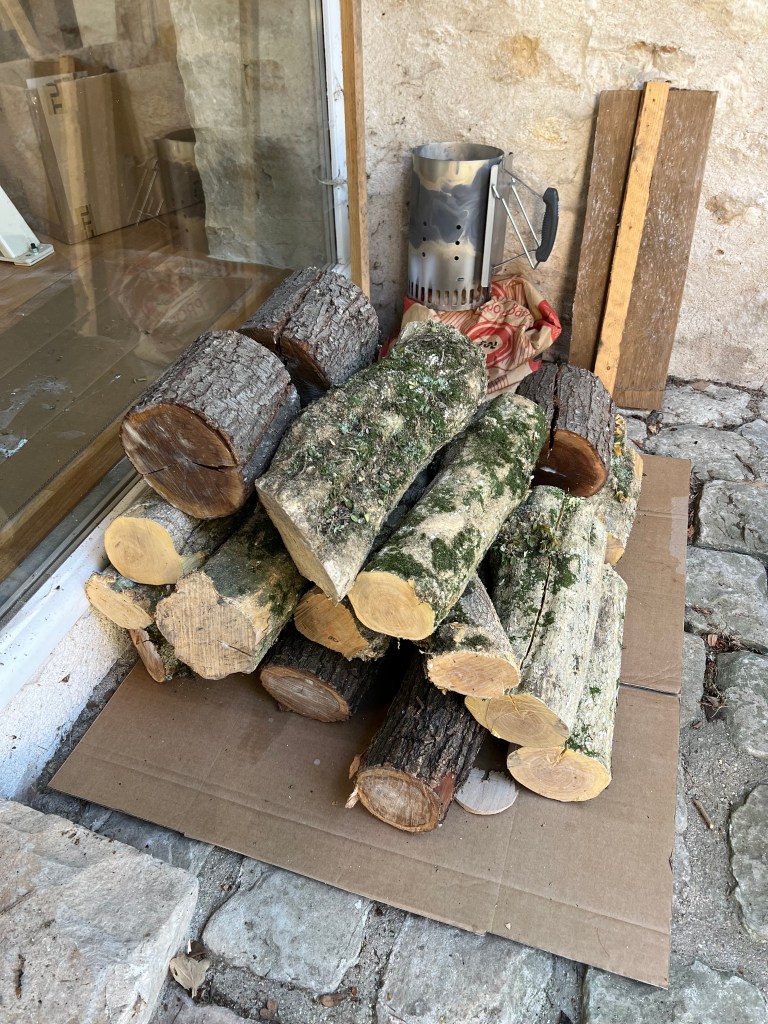
Boxwood logs, yellow and mossy, sit with a darker wood of a species unknown. The traces of white on the ends is a coating of wax which clears as it dries.

Fast forward to November, I split and turned a half of that darker wood. The bowl pictured below is the result. My best guess for the species is European plum, prunus domestica. This could be from a tree known in Britain as a greengage — Reine-Claude in France. It is common to the area where the wood was collected and my turning studio is found.
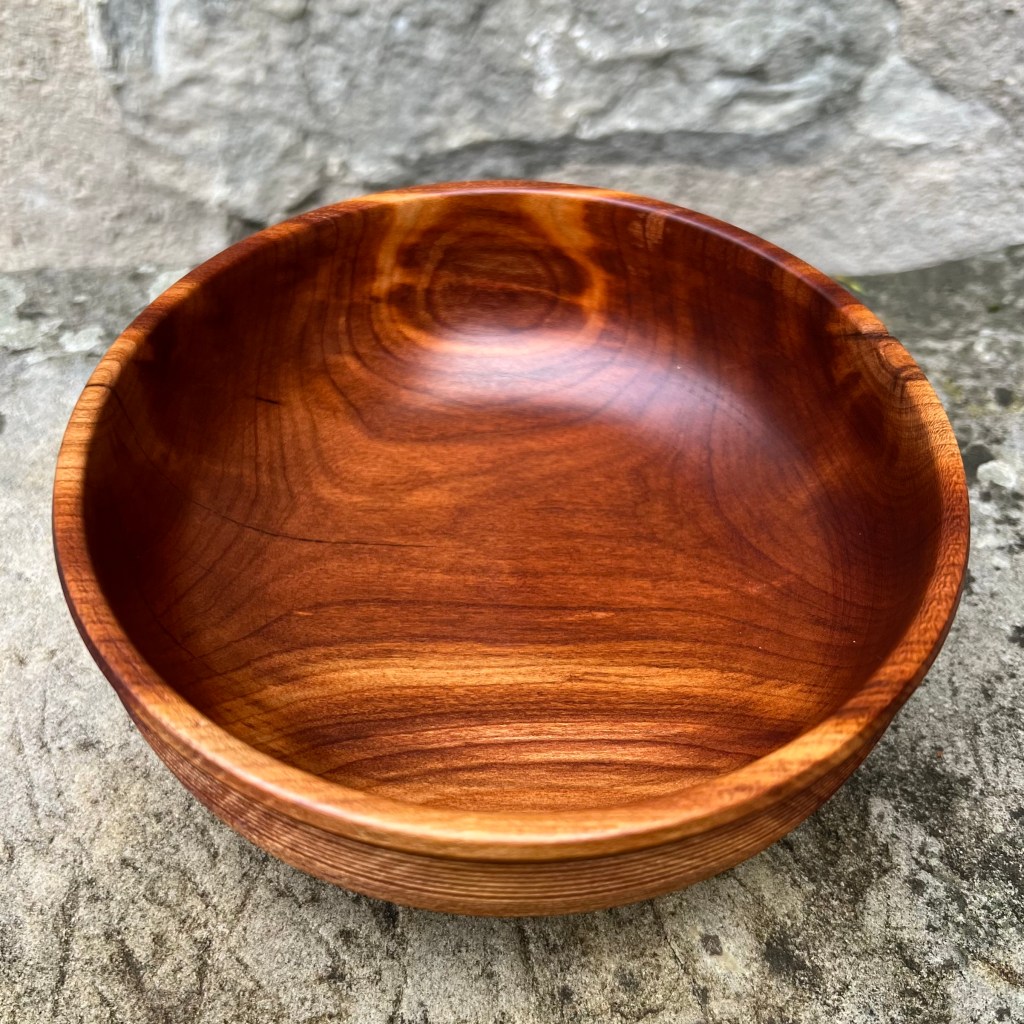
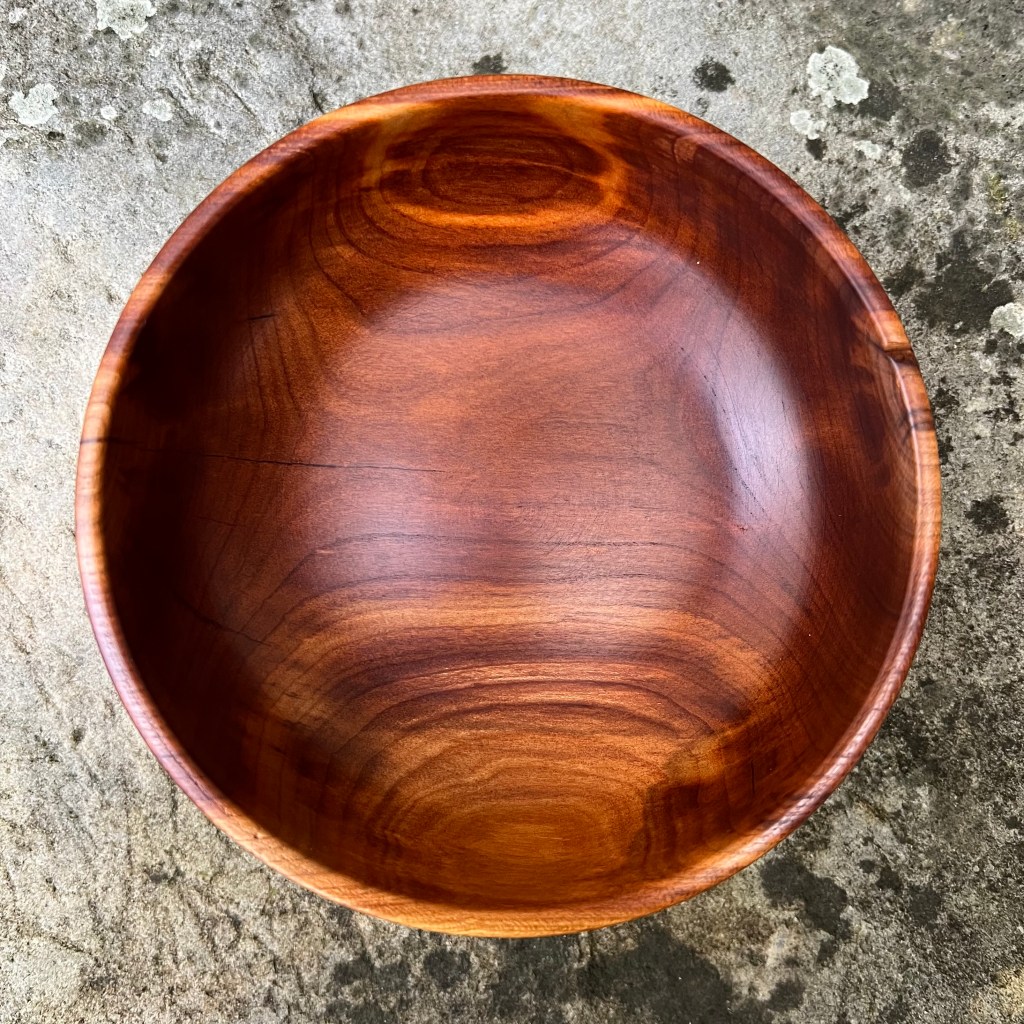
Bowl — wood species unknown?

Sassafras bowl

It’s the leaves and bark of the sassafras which are aromatic — once the bark is off the log,  the aroma is lost. The wood remains handsome though, its dark end grain giving way to a pale yellow along the grain.

The bowl is about 4 ½” in diameter and 2″ tall. Turned from a wet blank already showing some splits, it remained relatively stable during its time on the lathe. The exterior was charred with a propane torch before an oil and wax finish was applied.

Sassafras is brittle and, as I pushed the limits on how thin a bowl I could achieve (3/32″ at the sides and bottom), the rim did break in places.

It’s a pleasure to use this bowl which might explain why I did not give it away. It’s quite light, mimicking the delicate potato chips which sometimes fill it.

Thanks go to my sister Kay and her husband Greg for providing the blank.

Sassafras bowl

Dice cups

A travel-size backgammon set purchased as a gift came without dice cups. I asked the game seller: “Do you sell dice cups which I can use with this set?” “No.” Following with what seemed to be a gaming-world snoot, he noted these are not needed: “I’ve never used dice cups to play backgammon. And look at how shallow the board is, no dice cup is going to fit into that.” He was pointing at half of the open set.

I thought about arguing the point about the depth of the space with the board closed but the look on his face told me that he would not accept this nor, perhaps, any known laws of physics.

Instead…challenge accepted. Bonus: a follow-up birthday gift.

Settled by the fire in Shepherdstown with the inside air temperature at 55° and a whisky perched nearby, I sketched a pair of dice cups. I had 2 criteria to meet: 1) I must use material on hand & 2) I must complete the project in less than a day.

A short detour to a video on turning lidded boxes provided the last hint to what might be a success — turn 2 cups which acted as lids for each other. I turned a quick mockup to reveal any kinks in the process and selected a piece of myrtle from a stash of turning blanks for the final. I was done with plenty of time to pack and catch my plane.

The fit of the cups is such that they separate with a satisfying pop. The thickness of the cup wall and the density of the wood yield a lovely tone with the shake of the dice.

Only one question remained: Did I close the flue?

The cups when joined are 4 ¾” (120mm) tall × 1 ½” (33mm) around. The hollow is 1″ (25mm) in diameter.

Dice cups