Bar top refinish

I am not afraid to admit that while I recognized this job needed to be done, I was afraid to do it. Part of the need to do the refinishing was because of the small extension I added. Yes, I could have spent some time making that extension “match” in a way. After all, the oak I had used too build the bar back pieces was sourced such that it already looked like a patchwork of multiple species.

The finish on the oak bar top at the Coq & Bulldog had seen better days. The top remained as is since the opening of the pub in 2010-ish so was now a collection of burns, stains, and damage from liquids. I had already done the work of lifting one sagging corner but I was never going to make it level, if it ever was. The owner mentioned a benefit of this: that when things spill, they run to the back bar, not to a client’s lap. I am not certain if this was intentional.

So there I was, ready to hit it with a Festool Rotex set for more aggressive removal and some 80/120 sanding discs. I was surprised at how easily the existing finish came off and brought out the bare oak. The original finish did include a tint but it appears as though it was integral to the film of the finish and not a penetrating stain applied to the bare wood.

Some stains from years of use and abuse were harder to remove than others. The stains at the bottom of 2 beer taps was not going to come out. Without patching the wood, a couple of cigarette burns were there for the long run. That I was sanding so aggressively in spots meant that the bar would also not be completely flat. Given that it already is not level I did not worry that no one could use it as a reference surface.

The existing main angled joint in the 2 runs of the bar was remarkably tight. I did add some cyanoacrylate glue with saw dust to fill the small gap that had developed over the years. I treated my new joint at the bard end in similar fashion, as I had done all I could to get that as tight as I could with the skills and tools on hand.

Sanding went from the aforementioned 80/120 to 220 grit. The coating on the bar is Osmo Topoil. I poured the first coat out of the can in areas about 2 sf at a time and followed behind with a cotton rag to spread it thin. I worked from dry to wet until then end.

Topoil calls for 2 coats but I did 3. For each coat I used a Festool White Viel to assure a uniform application before drying. After the first coat cured, I sanded with 320; after the second coat cured I sanded with 40.

Water now beads up on the bar. I know that won’t last but with some regular cleaning with an oil-soap (Osmo sells one in a convenient spray bottle) the next refinish might be easier than this one.

(I am finishing this post a couple of years after I wrote the draft. The bar top still looks good and performs and cleans easily.)
Bar top refinish

Bowl — wood species unknown?

We call it Craig’s List on steroids. My wife, a prolific user of Le Bon Coin, had saved a search for “wood” with the hope of finding stock for my nascent woodturning studio. It had not been too long running when she asked if I’d be interested in some buis — someone was selling boxwood.

Generally growing to a modest size and trimmed regularly to fixed shapes, boxwood can grow up to 8 meters tall when left to grow. With a circumference rarely allowing anything but a modestly sized bowl, it is sought after for turning and carving smaller pieces. What small pieces might come from this newfound stash I do not yet know, although I do dream of turning a chess set some day.

When we went to review and eventually purchase the boxwood trunks, the family cleaning their property asked if I was also interested in a some wood of another species. The diameter was decent and the red-brown heartwood looked interesting. We took those as well and then left for the summer.

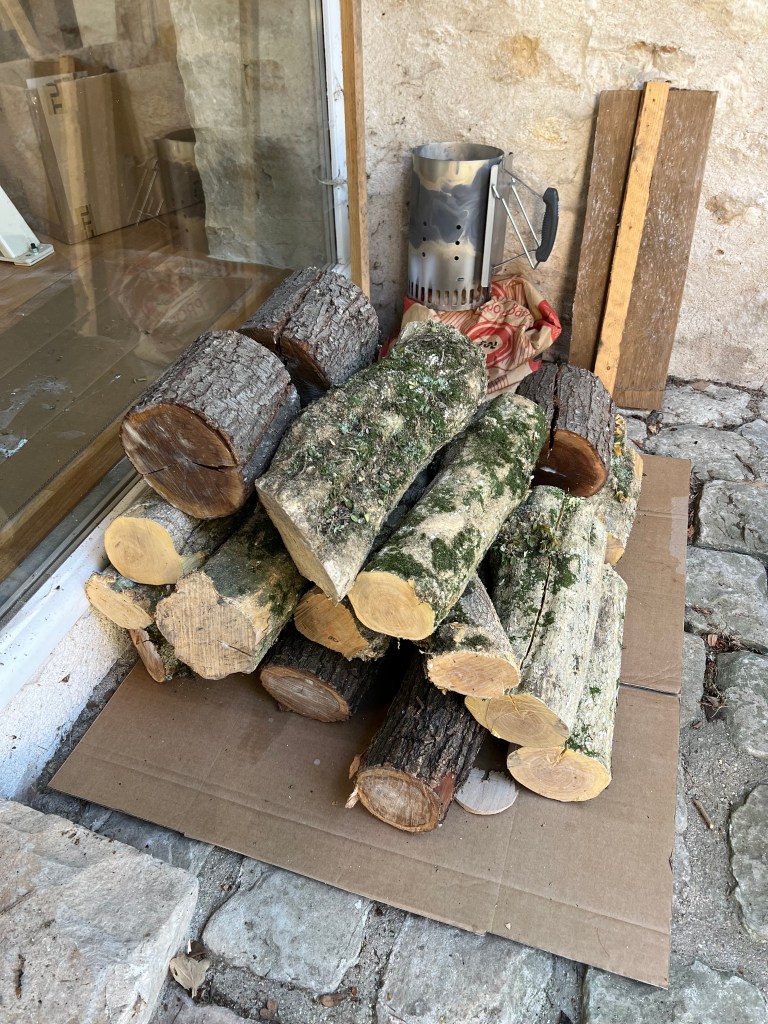
Returning in the fall, I took to cutting the logs to workable lengths and sealing their ends. Of course we had forgotten the species of the other tree! While the boxwood remained remarkably stable over the summer, the other was checking with extraordinary gusto, as seen in the image below. I sealed the newly exposed ends anyway, hoping that future drying would put most of its effort into the major splits appearing in the middle of each length.

Boxwood logs, yellow and mossy, sit with a darker wood of a species unknown. The traces of white on the ends is a coating of wax which clears as it dries.

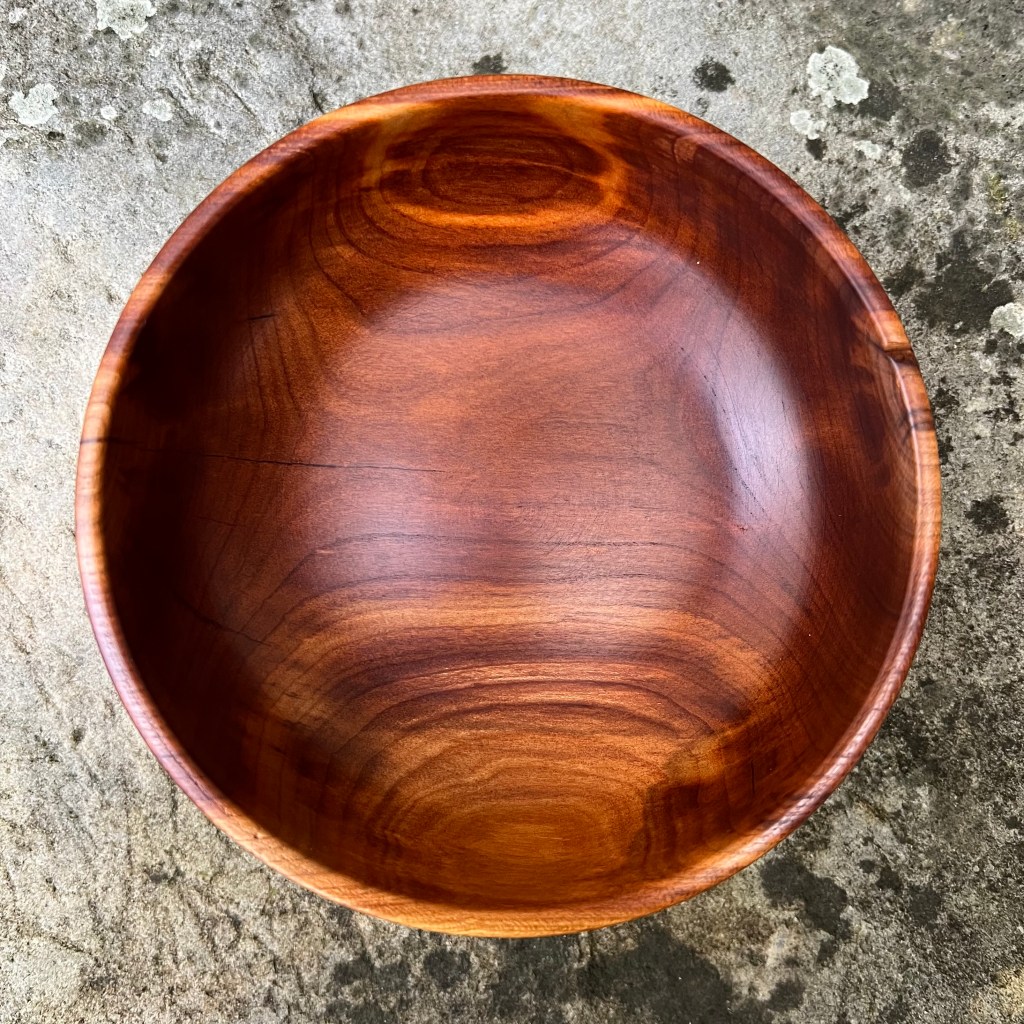
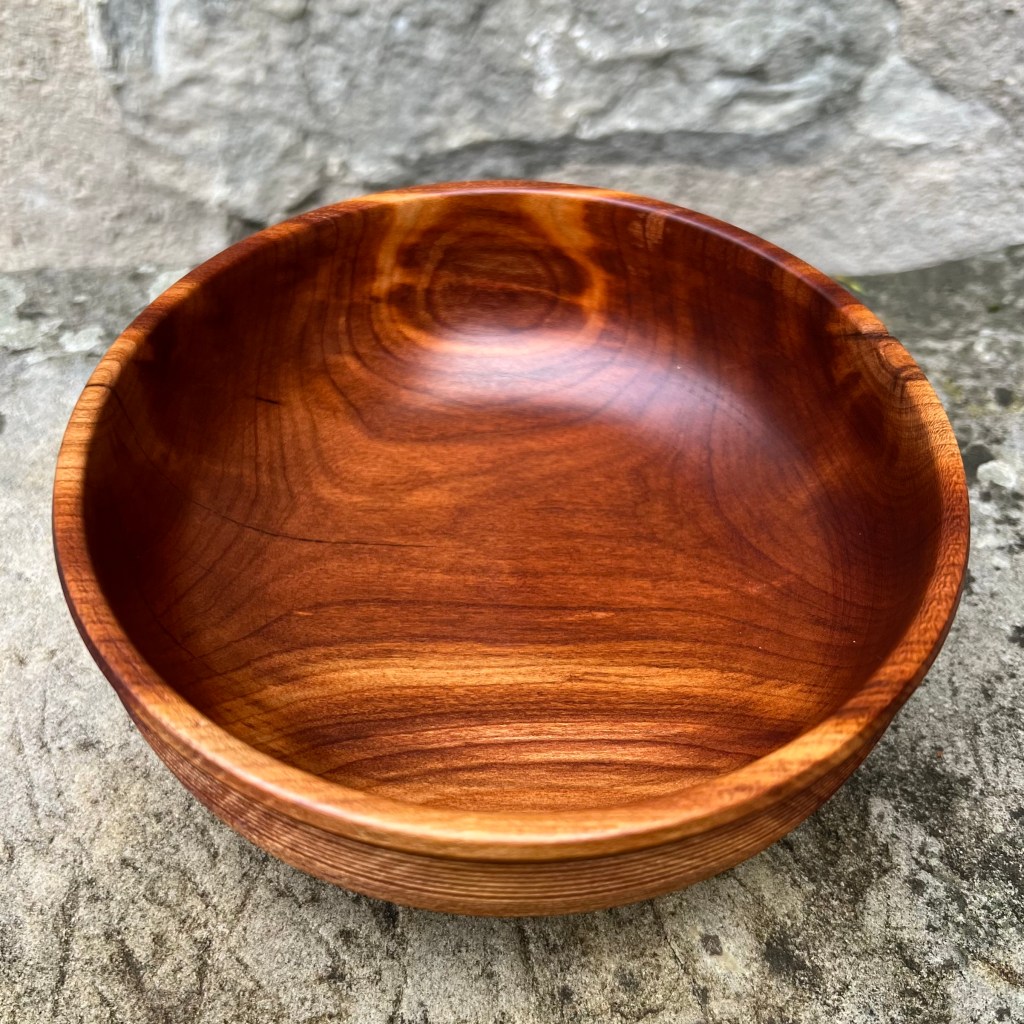
Fast forward to November, I split and turned a half of that darker wood. The bowl pictured below is the result. My best guess for the species is European plum, prunus domestica. This could be from a tree known in Britain as a greengage — Reine-Claude in France. It is common to the area where the wood was collected and my turning studio is found.

Bowl — wood species unknown?

Sassafras bowl

It’s the leaves and bark of the sassafras which are aromatic — once the bark is off the log,  the aroma is lost. The wood remains handsome though, its dark end grain giving way to a pale yellow along the grain.

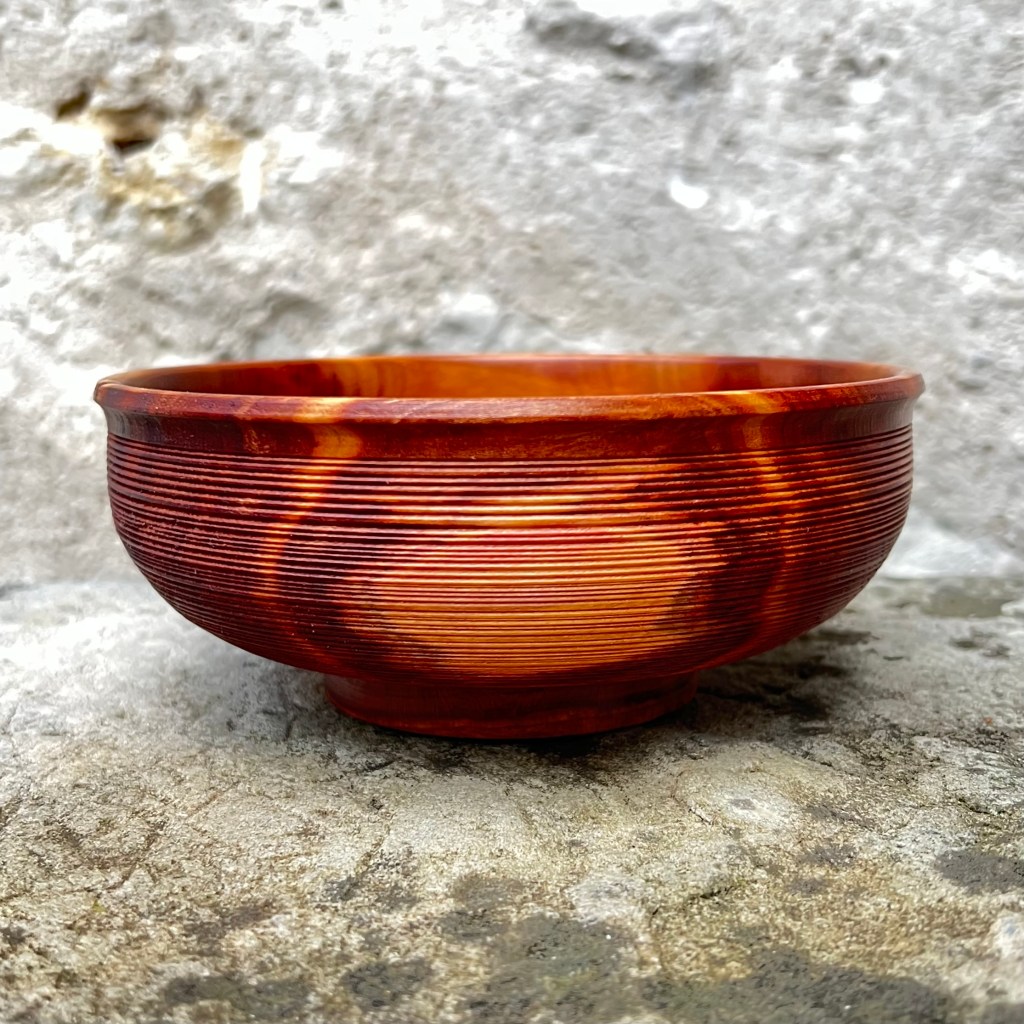
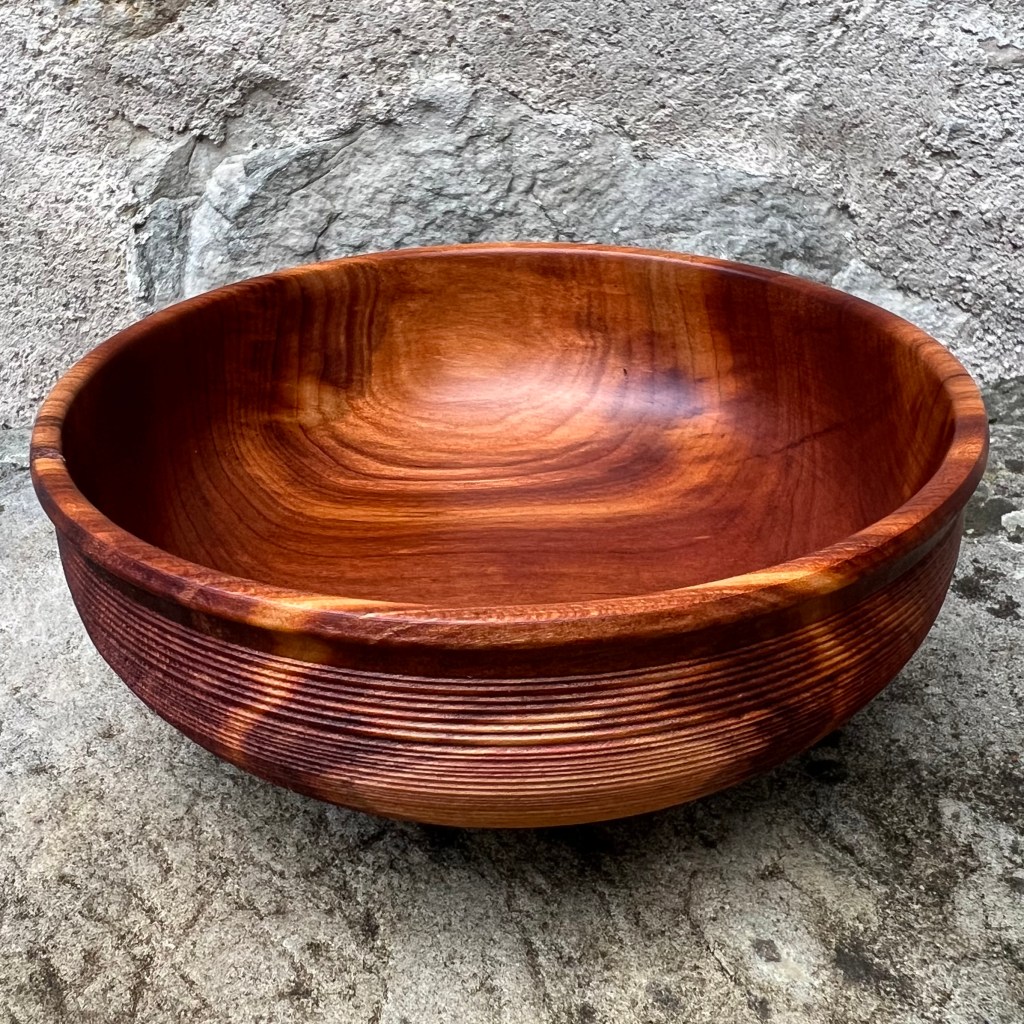
The bowl is about 4 ½” in diameter and 2″ tall. Turned from a wet blank already showing some splits, it remained relatively stable during its time on the lathe. The exterior was charred with a propane torch before an oil and wax finish was applied.

Sassafras is brittle and, as I pushed the limits on how thin a bowl I could achieve (3/32″ at the sides and bottom), the rim did break in places.

It’s a pleasure to use this bowl which might explain why I did not give it away. It’s quite light, mimicking the delicate potato chips which sometimes fill it.

Thanks go to my sister Kay and her husband Greg for providing the blank.

Sassafras bowl

Picture Rail

Built to not just hang prints but also to support album covers, this picture rail was built as a gift for friends.

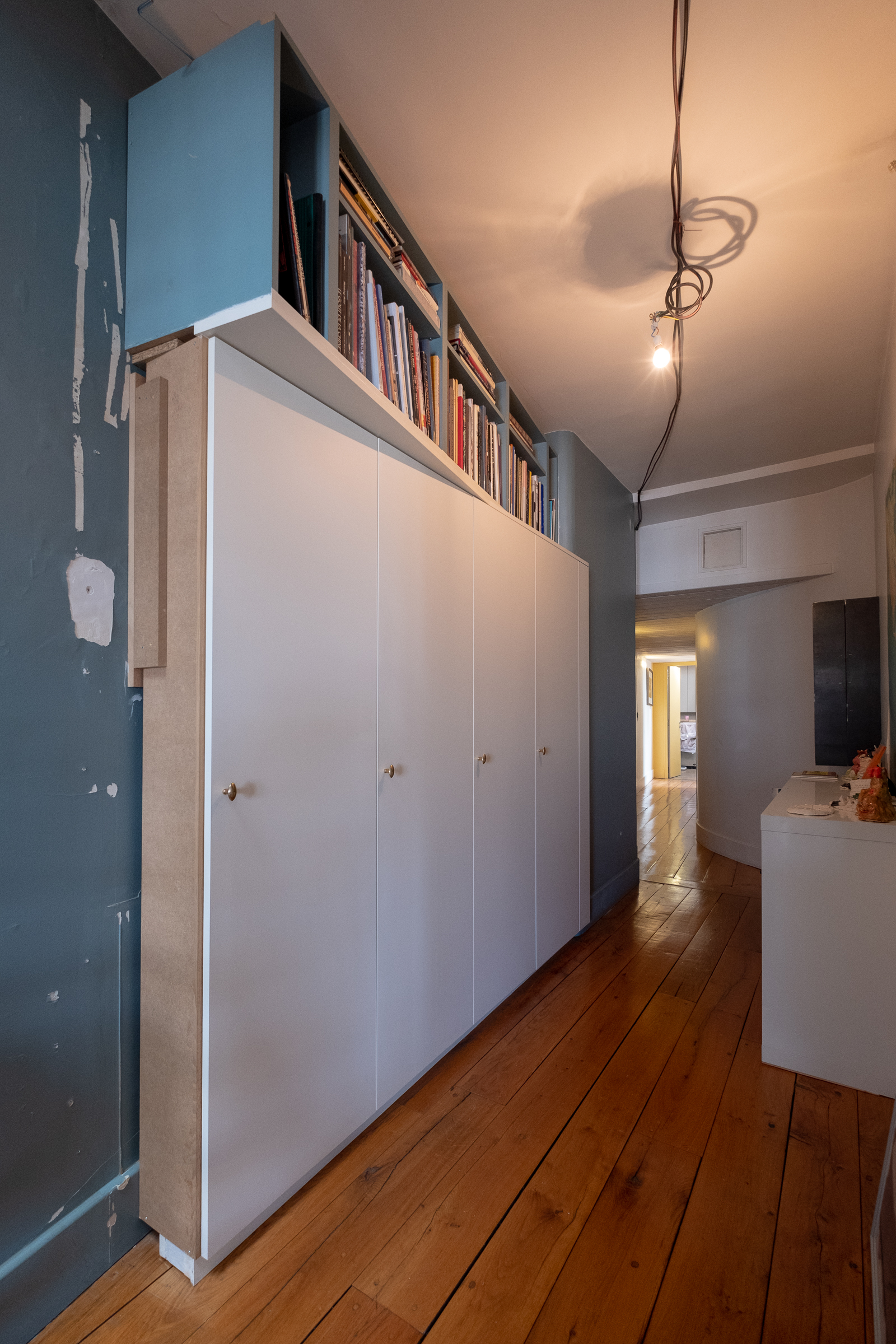
The bi-folding, flush doors seen in the corners of 2 images are my paid work — built to close their salon when in use as a bedroom for overnight guests.

The rail is built with 4 pieces: a backer (1) which anchors the assembly to the wall, an upper rail (2) to support the album covers (the final was grooved, not lipped), a dowel (3) to support hooks for framed prints; in concert with the dowel, a cove (4) finishes the backing wall support and echoes the original crown of the space. Those two pieces also work together to conceal the wall anchors.

The wood is clear pine, selected for its light weight and paintability. Painting the rail was essential — not just to maintain the spirit of the apartment trim but for adjusting the rail to walls that are neither straight nor square.

Picture Rail

Dice cups

A travel-size backgammon set purchased as a gift came without dice cups. I asked the game seller: “Do you sell dice cups which I can use with this set?” “No.” Following with what seemed to be a gaming-world snoot, he noted these are not needed: “I’ve never used dice cups to play backgammon. And look at how shallow the board is, no dice cup is going to fit into that.” He was pointing at half of the open set.

I thought about arguing the point about the depth of the space with the board closed but the look on his face told me that he would not accept this nor, perhaps, any known laws of physics.

Instead…challenge accepted. Bonus: a follow-up birthday gift.

Settled by the fire in Shepherdstown with the inside air temperature at 55° and a whisky perched nearby, I sketched a pair of dice cups. I had 2 criteria to meet: 1) I must use material on hand & 2) I must complete the project in less than a day.

A short detour to a video on turning lidded boxes provided the last hint to what might be a success — turn 2 cups which acted as lids for each other. I turned a quick mockup to reveal any kinks in the process and selected a piece of myrtle from a stash of turning blanks for the final. I was done with plenty of time to pack and catch my plane.

The fit of the cups is such that they separate with a satisfying pop. The thickness of the cup wall and the density of the wood yield a lovely tone with the shake of the dice.

Only one question remained: Did I close the flue?

The cups when joined are 4 ¾” (120mm) tall × 1 ½” (33mm) around. The hollow is 1″ (25mm) in diameter.

Dice cups

Pear wood bowl

Turned over the course of a few days…getting my seasonal feet wet on the lathe with something bigger than usual.

This bowl came from a half-log section given to me by our arborist some years ago. The wood is undoubtedly still wet although it feels and behaves as if dry — for the moment. Two hairline cracks appeared while turning. Sanding and finishing bowls remains a struggle for me — I spent some time trying to eliminate the flats in the interior curve with moderate success. Sanding marks remain. Sometimes it’s necessary to move on to the next thing.

I gave this bowl to a visitor from Connecticut. She’s a childhood friend of my sister who also appreciates the view and the food here.

Pear wood bowl

Utility closets

DSCF1646Aside from the hardware, this project was completed with scrap material from my atelier and a repurposed bookshelf. The design was adjusted to use only single sheet divisions between each box — aside from the first, each box is, in their means of construction, only three sides and a back. The base, end panels, and trim between the repurposed bookcase await completion. The door finish will be paint to match the wall when final painting on this section of the apartment is complete. The bookshelf is from the year 2000.
Utility closets

Dining room cabinets

26277575052_fc940a9252_k
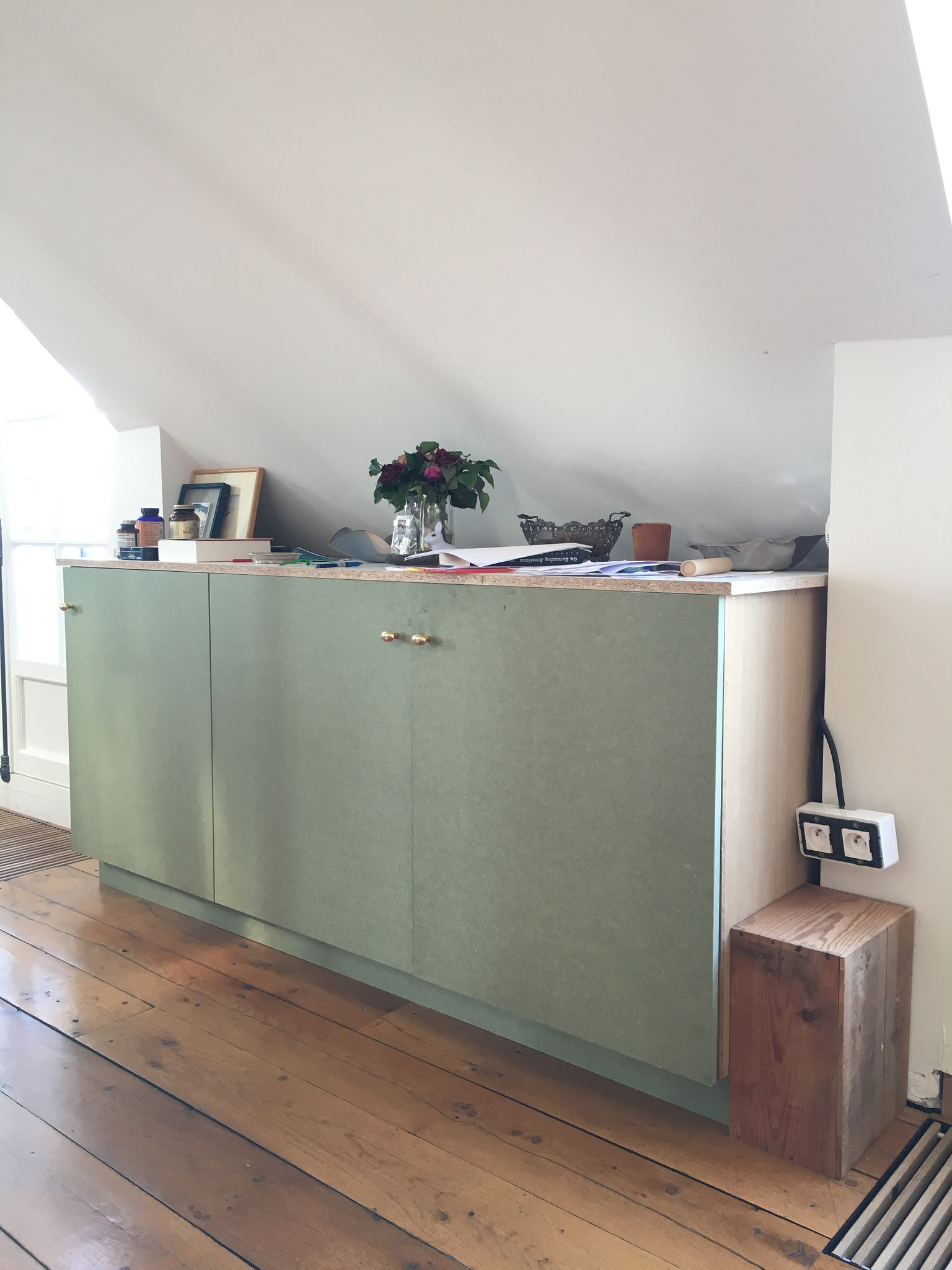
Dining room cabinets: 2015; approx. 2m long by 86cm tall.

These three cabinets are of an MDF exterior (medium) to be receive a painted finish upon completion of this portion of the apartment. The two cabinets on the right each include three interior trays of marine grade plywood with oil-wax finish. The trays are supported by full-extension undercount glides of varying depths, the longest being nearly a meter long. The carcasses are of oak veneer plywood with a water based polyurethane finish. The unit on the left is a built-in freezer. The top is temporary, to be replaced in it’s final form with stone. At that time, ends panels will be provided to match the adjacent wall and the electrical outlets will be built into a backsplash with the top.

Dining room cabinets